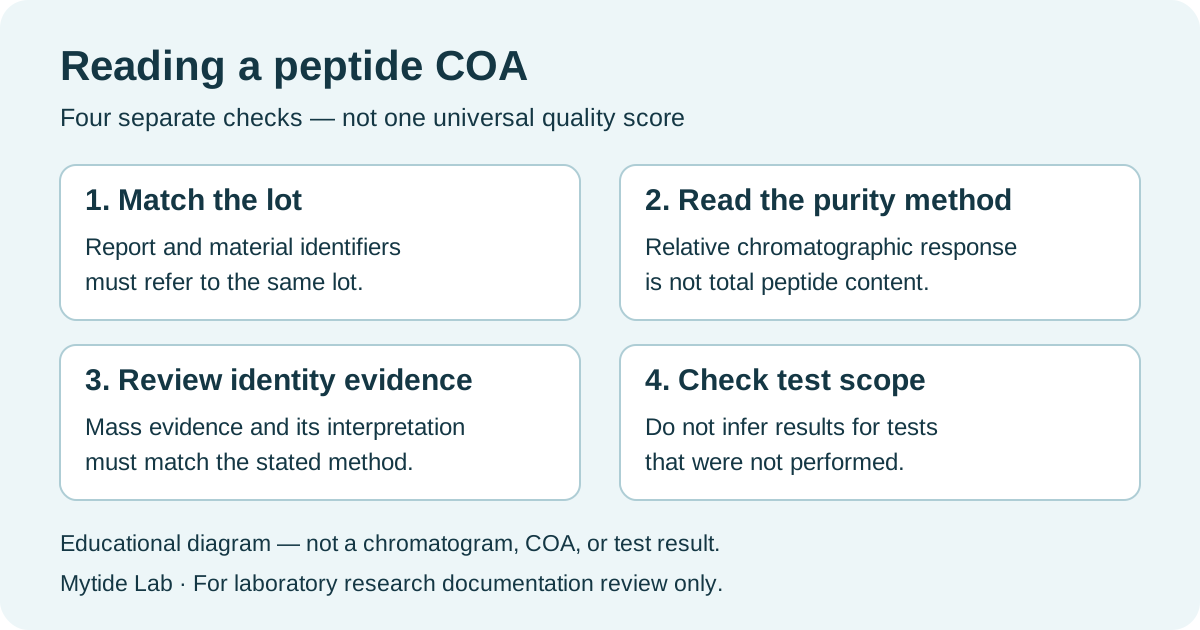
Read a peptide Certificate of Analysis (COA) by matching the report to the lot, checking the laboratory and methods, then reviewing purity and identity evidence separately. A purity percentage alone does not establish identity, peptide content, sterility, or suitability for an experiment.
This research-use-only guide explains how to review those fields without treating a purity percentage as proof of identity. You can also compare Mytide Lab's currently published, lot-specific documents on the peptide COA and lab reports page. Products still awaiting documentation are marked pending there instead of being presented as COA-backed.
What Is a COA?
A Certificate of Analysis is a document that reports the results of quality testing performed on a specific batch of peptide. It typically includes:
- Identity confirmation (is this actually the peptide you ordered?)
- Purity measurement (the relative analytical response under the reported method)
- Physical characteristics (appearance, solubility)
- Batch-specific information (lot number, manufacturing date)
Think of it as a peptide's report card. And just like report cards, you need to know what the grades mean.
Section 1: Product Identification
At the top of any COA, you'll find basic identification information:
- Product name - The peptide name (e.g., BPC-157, TB-500)
- Catalog/Product number - Supplier's internal reference
- Lot/Batch number - Unique identifier for this specific production batch
- Molecular formula - The chemical formula (e.g., C₆₂H₉₈N₁₆O₂₂ for BPC-157)
- Molecular weight - Expected mass in Daltons
- Sequence - The amino acid sequence of the peptide
- Quantity - How much peptide is in the vial
What to check: Make sure the sequence and molecular weight match the peptide you ordered. This sounds basic, but it's your first line of defense against receiving the wrong compound.
Section 2: HPLC Purity - One Part of the Evidence
HPLC (High-Performance Liquid Chromatography) can estimate the relative purity of components detected under the stated method. It does not, by itself, establish that the main peak is the intended compound. Review HPLC alongside identity data, the reported method, and the lot number.
How HPLC Works
The peptide sample is dissolved and pushed through a column packed with tiny particles. Different molecules travel through the column at different speeds based on their size and chemical properties. A detector at the end measures what comes out and when.
The result is a chromatogram: detected signal plotted against retention time. Peak size alone does not identify a compound. Interpret peak assignments using the laboratory's method and supporting identity evidence.
What the Numbers Mean
An HPLC percentage is method- and sample-specific. Read the reported value directly from the lot-specific document and check whether the report includes a chromatogram, integration table, test date, sample identifier, and laboratory name. Do not substitute a catalog-wide average or product-page specification for the result on the report tied to the material being reviewed.
For a concrete analytical example, Waters describes calculating relative purity from integrated UV peak areas. That example illustrates a method, not a result for Mytide material.
| Report field | Question it helps answer | Do not infer from it alone |
|---|---|---|
| Lot identifier | Does this document refer to the material being reviewed? | That every catalog item has the same result |
| Chromatographic purity | What fraction of integrated response belongs to an assigned peak? | Identity, net peptide mass, or sterility |
| Mass spectrometry | Is the observed mass consistent with the proposed compound and method? | Complete sequence or stereochemical proof |
| Separate content or microbiological tests | What did those specific assays measure? | Results of tests not actually performed |
Reading the Chromatogram
If the COA includes the actual HPLC chromatogram graph, here's what to look for:
- Peak assignment - Check how the laboratory identified the peak used in the purity calculation.
- Clean baseline - The flat line between peaks should be relatively smooth, not jagged or elevated.
- Secondary peaks - Review the integration and reported assignments rather than judging purity from peak height alone.
- Retention time - Compare only under the stated analytical conditions; it is not a universal identifier.
Common HPLC Impurities
- Deletion sequences - Peptides missing one or more amino acids from the synthesis
- Truncated sequences - Incomplete peptide chains
- Oxidation products - Especially common for peptides containing methionine or cysteine
- Racemization products - Amino acids in the wrong stereochemical configuration
- TFA salts - Residual trifluoroacetic acid from purification (usually listed separately)
Section 3: Mass Spectrometry (MS)
Mass spectrometry provides evidence about molecular mass. A matching intact mass supports an identity assessment but should not be described as complete proof of sequence or structure. Agilent distinguishes intact-mass analysis from peptide mapping and fragment-based sequence confirmation.
How It Works
The peptide is ionized and sent through a mass analyzer that separates molecules by their mass-to-charge ratio (m/z). The result shows the observed molecular weight, which should match the theoretical molecular weight.
What to Look For
- Observed mass vs. theoretical mass - Use the laboratory's stated tolerance and the same mass convention; do not apply a universal ±1 Da cutoff.
- Method and interpretation - Identify the instrument, ionization method, charge states and any deconvolution used.
- m/z values - You may see multiple values representing different charge states (e.g., [M+H]⁺, [M+2H]²⁺). This is normal.
Example
Compare the observed ions and charge-state interpretation with the theoretical mass stated for the compound. The acceptable tolerance depends on the instrument, ionization method, calibration, adducts, and report method, so a universal pass/fail cutoff should not replace the laboratory's stated criteria.
Section 4: Appearance and Physical Properties
This section describes what the peptide looks like and how it behaves:
- Appearance - Usually "white to off-white lyophilized powder." Yellow or brown color can indicate degradation.
- Solubility - States which solvents the peptide dissolves in (typically water, BAC water, DMSO, or dilute acetic acid)
- pH - The pH of a solution at a specified concentration
These might seem minor, but they're useful for confirming you received what you expected and for troubleshooting reconstitution issues.
Section 5: Additional Tests
Some COAs include extra quality tests:
Amino Acid Analysis (AAA)
Measures amino acid composition after hydrolysis. Composition is not the same as amino acid order: a composition result should not be presented as sequence confirmation.
Peptide Content
A content assay addresses the amount of peptide relative to the stated sample basis. Read the actual method, units and result; do not assume a typical percentage for an untested lot.
Important: Peptide content is not the same measurement as HPLC purity. Water, counterions, salts, and other components may affect total mass. Their relevance depends on the material and experimental design, so review the actual report rather than assuming they are immaterial.
Endotoxin Testing (LAL)
Measures bacterial endotoxin levels. Important for in vivo research applications. Results are typically reported in EU/mg (Endotoxin Units per milligram).
Sterility Testing
Confirms the absence of microbial contamination. Not all suppliers include this, but it's valuable for sensitive research protocols.
Red Flags: When to Question a COA
Here are warning signs that a COA might not be trustworthy:
1. No Lot Number
Every COA should reference a specific batch. A generic COA without a lot number suggests the document may not represent the actual product you received.
2. Perfect Round Numbers
Rounding alone does not establish whether a report is genuine. Ask for the method, reporting precision and supporting analytical records when a result is unclear.
3. Missing Chromatogram
The best COAs include the actual HPLC chromatogram graph - not just a number. If a supplier only provides a purity percentage without supporting data, ask for the full chromatogram.
4. No MS Data
HPLC purity alone does not establish identity. Look for an orthogonal identity method, such as mass spectrometry, and verify that the sample or lot identifier matches the rest of the documentation.
5. Unrealistic Purity Claims
A catalog-wide purity claim is not a substitute for a lot-specific result. Check that each claim is supported by the corresponding report rather than accepting or rejecting it from the percentage alone.
6. Third-Party vs. In-House Testing
Independent testing can provide useful separation between seller and laboratory, but it still requires basic verification: laboratory identity, report date, lot match, method details, and an unaltered report file.
How to Use COA Data in Your Research
For Publication
If you're publishing research, include the peptide supplier, catalog number, lot number, and purity in your methods section. Reviewers and readers need to know the quality of materials used.
For Troubleshooting
If you're getting unexpected results, the COA is your first diagnostic tool:
- Low purity could explain inconsistent dose-response curves
- Wrong molecular weight means you might have the wrong compound
- High counterion content (low peptide content) means your actual peptide mass is less than the total weight
For Comparing Suppliers
COAs let you objectively compare peptide quality between suppliers. When evaluating a new source, request COAs for several products and check them against the criteria above.
Mytide Lab COA Standards
Mytide Lab separates published documentation from pending records on the lab reports page. Downloadable reports are currently shown for GHK-Cu, PT-141, Retatrutide, Tirzepatide, NAD+, and Wolverine Blend. Each published entry displays its reported lot, laboratory, purity value, and available report files. A product marked pending should not be interpreted as having a completed, product-specific COA.
Match the lot on the downloadable report to the material under review. For a report that is not published, contact Mytide Lab with the product and lot identifier rather than relying on a general purity statement.
Quick Reference: COA Checklist
Use this checklist when reviewing any peptide COA:
- ✅ Lot/batch number present
- ✅ HPLC result and chromatogram are tied to the same sample or lot
- ✅ Mass spectrometry interpretation is consistent with the stated method and theoretical mass
- ✅ Amino acid sequence listed and correct
- ✅ Physical appearance described
- ✅ Peptide content percentage stated
- ✅ Date of analysis
- ✅ Testing laboratory identified
If key identity, lot, method, or laboratory details are missing, ask for more complete documentation before using the material in a research workflow.
This page is educational and intended only for laboratory research sourcing and documentation review. Mytide Lab products are not for human consumption, medical use, or therapeutic application.